15-17 December 2025
The second Global Refugee Forum (GRF) Progress Review meeting took place marking mid-way between the 2023 and 2027 GRFs to stake stock of implementation of the Global Compact on Refugees (GCR) and maintain momentum and political support for further progress. Organised in the final weeks of a tumultuous 2025 and Filippo Grandi’s decade-long service as the United Nations’ High Commissioner for Refugees, the meeting marked a pivotal moment of transition for the Agency and presented an opportunity to reflect on the broader transformations reshaping the humanitarian and development sectors, and to consider how these evolving dynamics will influence refugee protection frameworks in the years ahead.
For EGRISS, the meeting deliberations validated the importance of “statistical inclusion” as an integral part of enabling and implementing the four objectives of the GCR. The inclusion of data on refugees, IDPs, and stateless populations in nationally owned statistical exercises, informed by EGRISS’ International Recommendations, was highlighted as a good practice in connection to several thematic areas. The centrality of high-quality national statistics emerged as a cross-cutting enabler, whether ending statelessness, strengthening the nexus between humanitarian action, development and peace, pursuing inclusive education, social protection or economic employment policies, enhancing sustainable responses in refugee situations, or more widely monitoring progress against the GCR indicator framework.
Highlights included:
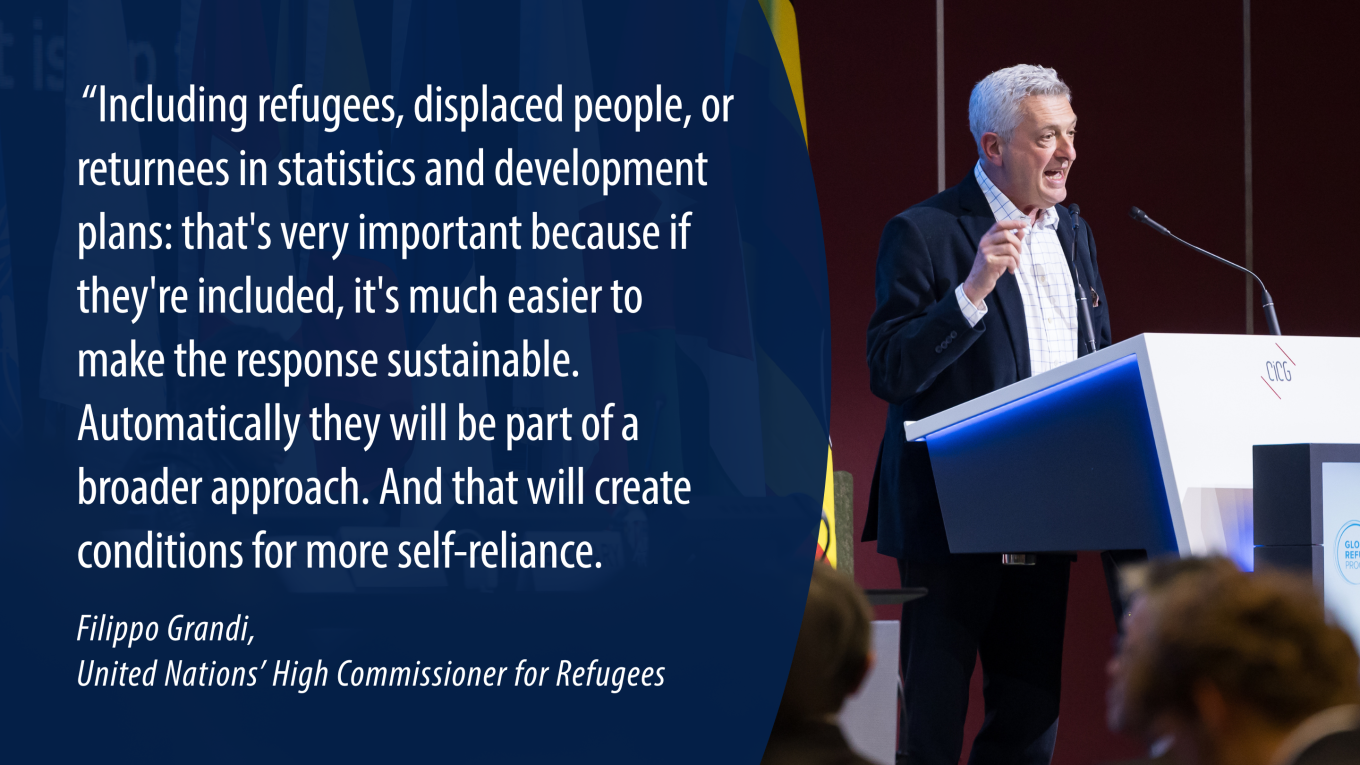
- High Commissioner Grandi’s explicit call for including refugees and displaced persons in national statistics in a passionate opening statement in a session on sustainable responses: sustainable responses need “host countries to include refugees, IDPs and returnees in national statistics, in development plans…that will create conditions for more self-reliance.”
- The UK Foreign, Commonwealth and Development Office’s complementary intervention in the same session highlighted technical support provided by Office for National Statistics (ONS) to multiple displacement-effected countries.
- The strategic dialogue on the GCR indicator framework featured multiple examples of National Statistical Office leadership in pursuing statistical inclusion with support from international and regional partners. This included direct experience from national, regional, and international perspectives, such as the Intergovernmental Authority on Development (IGAD), the International Labour Organization (ILO), Mauritania, and Honduras, as well as the announcement of a new pledge to support statistical inclusion from the Swedish International Development Cooperation Agency (SIDA).
- During the same session, the World Bank-UNHCR Joint Data Center on Forced Displacement (JDC) provided an overview of implementation progress concerning the multi-stakeholder pledge on statistical inclusion signaling a growing visibility of forcibly displaced in national statistics.
- EGRISS’s intervention on the International Recommendations on Statelessness Statistics (IROSS) in a session dedicated to statelessness generated keen interest from multiple participants.
- This was reinforced by the European Union Directorate-General for International Partnerships (DG INTPA) confirming its ongoing commitment to supporting countries in strengthening national statistical capacities.
- In the event “Accelerating HDP nexus approaches in forced displacement settings”, the Government of Denmark noted the tremendous work that has been done in recent years to produce high quality data for national policy making and programming.
Despite the challenging context in which the meeting took place, this brief read out highlights the growing recognition of the role of national statistical systems in the context of GCR implementation. Whilst the initiative to coordinate pledges on statistical inclusion at the 2023 GRF helped to enhance the visibility of the topic amongst policy-makers (progress has been demonstrated through GAIN Survey results and the recent EGRISS All Members Meeting discussions), the 2025 GRF Progress Review confirmed that statistical inclusion has now become a permanent feature of policy dialogue around GCR implementation – calling for more and better coordinated action to make further progress.