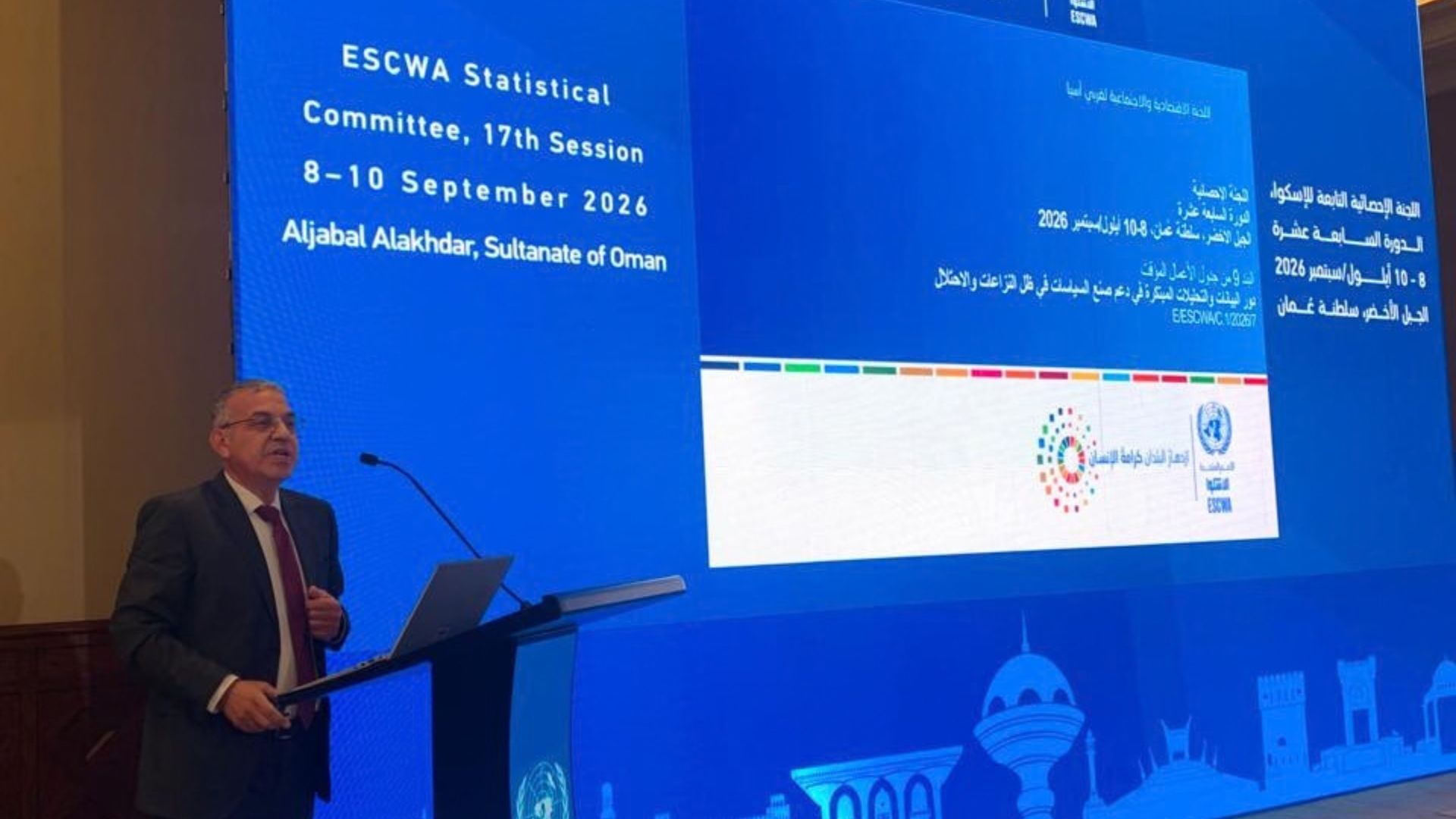
Increasing the quality of statistics on refugees and internally displaced persons in Arab countries was among the discussed topics at the seventeenth session of the United Nations Economic and Social Commission for Western Asia (ESCWA) Statistical Committee, held in Aljabal Alakhdar, Oman, from 8 to 10 September 2026. Under agenda item 10, the Committee examined a paper prepared by the ESCWA secretariat that traces the growing importance of statistics for development planning, humanitarian response, and the monitoring of affected populations, while providing practical recommendations to enhance work in this field.
Ismail Lubbad, Senior Statistician and Team Leader of the Demographic and Social Statistics Team at ESCWA, introduced the document. The paper draws on a regional survey first conducted in 2023 and updated in 2026, as well as on discussions from an EGRISS co-organised regional workshop held in Cairo in November 2024, and aims to assess progress made by Arab countries and identify remaining gaps. Lubbad noted that a third of the world’s refugees originate from the Arab region, despite displacement statistics remaining among the least available and least regularly produced data there — a gap he attributed to genuine barriers of access, infrastructure and limited capacity. He then outlined the paper’s core recommendations
- Reinforcing national leadership by anchoring displacement statistics within national statistical systems
- Adopting international recommendations and adapting them to local policy needs
- Integrating traditional and non-traditional data sources
- Closing persistent data gaps concerning Palestinian populations.
Natalia Baal, head of the EGRISS Secretariat, offered a broader perspective on progress achieved on this agenda globally, sharing evidence from the Global Annual Inclusion (GAIN) Survey that indicate a rising number of countries implementing the International Recommendations on Refugee, IDPs, and Statelessness Statistics (IRRS, IRIS and IROSS). She also drew on examples from different regional initiatives — including the new UNECE Task Force on Statistics on Refugees, Internally Displaced Persons, and Statelessness, the practical guide adopted by the Conference of American Statisticians and the African Union (AU) Guidelines on Migration and Displacement Statistics— and reflected that “regional cooperation has really proved to be the effective catalyst for progress,” and offered EGRISS’s continued support to Arab states, particularly on national capacity development.
Palestinian refugees on the spotlight
Sebastian Steinmüller, statistician at the United Nations Relief and Works Agency for Palestine Refugees’ (UNRWA) Relief and Social Services Department, then unpacked the specific complexities surrounding data on this group. As of end-2025, UNRWA’s registration records counted six million Palestine refugees worldwide (over 1.5 million in Gaza, 900,000 in the West Bank, 2.4 million in Jordan, and several hundred thousand each in Syria and Lebanon), tracked through registration, service records and, increasingly, through digital identity verification via a mobile application. He noted considerable overlap between international and internal displacement among this population
Steinmüller clarified a key statistical nuance: refugees remain registered with UNRWA even after moving outside the agency’s five operational fields (Gaza, the West Bank, Jordan, Lebanon and Syria), though those who relocate beyond these fields may fall under UNHCR’s mandate instead, creating a risk of double counting that both Agencies are working jointly to address. He also highlighted a new initiative with ESCWA and the Palestinian Central Bureau of Statistics to develop statistical guidance for Palestine refugees aligned with the IRRS, alongside ongoing efforts to align registration databases and methodologies with host-country governments.
Countries highlight challenges in displacement statistics
The floor then opened to country interventions that grounded these global and regional frameworks in national realities. Yemen’s representative described a new collaboration with the national Refugee Commission, cautioning that international agencies still lack a shared definition of displacement, which complicates coordination on the ground. She stressed that limited capacity within the national statistical office made it difficult to respond to the volume of reporting demands and called for international organizations to route their engagement through national statistical centers rather than other government bodies, so that the region can converge on one trusted set of numbers rather than competing estimates driven by funding interests.
Djibouti’s representative described strong coordination between the National Institute of Statistics and international organisations, including through its membership in EGRISS, and noted that a module on refugees and asylum applicants had been added to the 2024 census. The core difficulty, he explained, is that the country functions largely as a transit point rather than a destination for migrants and displaced people and underlined the challenge of access in certain geographical areas. Counting a population that is, by nature, passing through rather than settling, he noted, remains an ongoing methodological challenge.
Closing the discussion, Ismail Lubbad tied the interventions back to a common thread: the added value of common statistical frameworks and the persistent gap between registered and actual displaced populations, citing examples from Lebanon and Palestine in particular. He closed by underscoring that resolving definitional tensions, rather than merely collecting more data, is the region’s most pressing task ahead.
Continued collaboration between national statistical offices, EGRISS, ESCWA, UNRWA, UNHCR and other relevant partners will provide guidance and technical support to Arab countries. This will include helping countries assess data and capacity gaps, identify priority needs, and integrate refugee and displacement statistics into national statistical systems, including censuses, surveys and administrative data. Support will also focus on sharing experiences and good practices, particularly in monitoring mobile populations and integrating different data sources. Regional and national advocacy and coordination will be essential to helping countries put relevant international recommendations and standards into practice.