GAIN Questionnaires, Glossary
& Frequently Asked Questions
Download the latest survey questionnaires in your language, look up key definitions, and find answers to common questions.
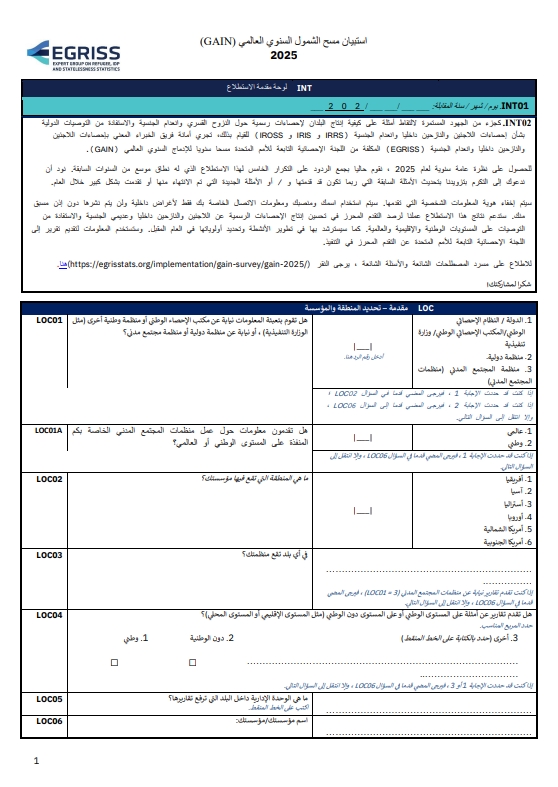
Survey Questionnaires
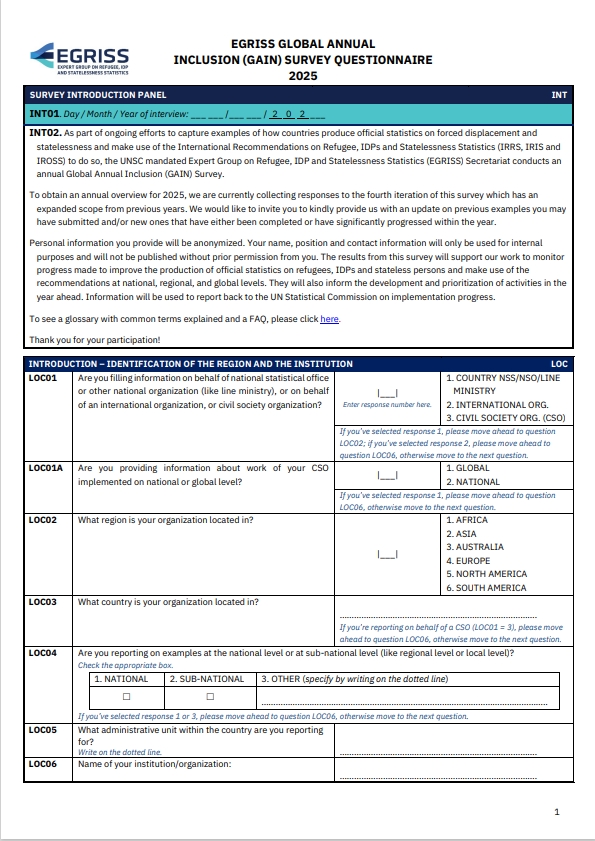
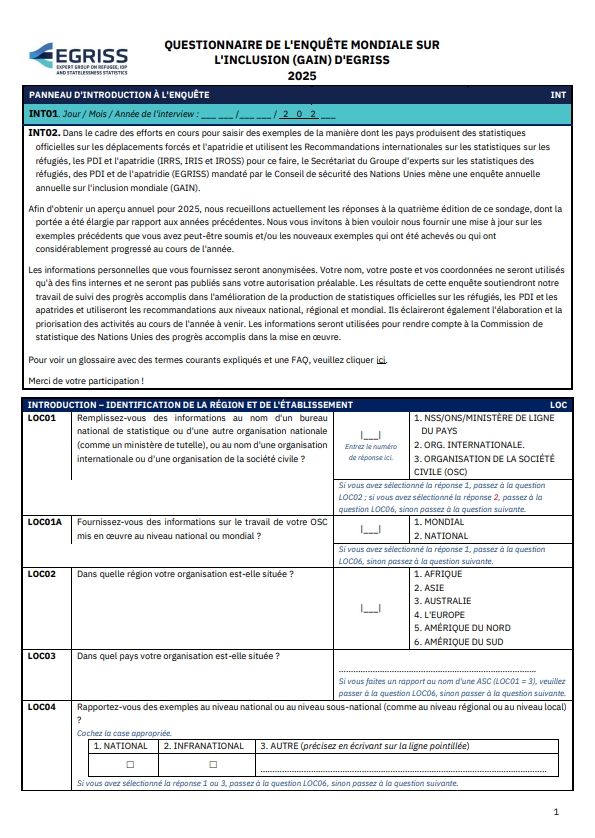
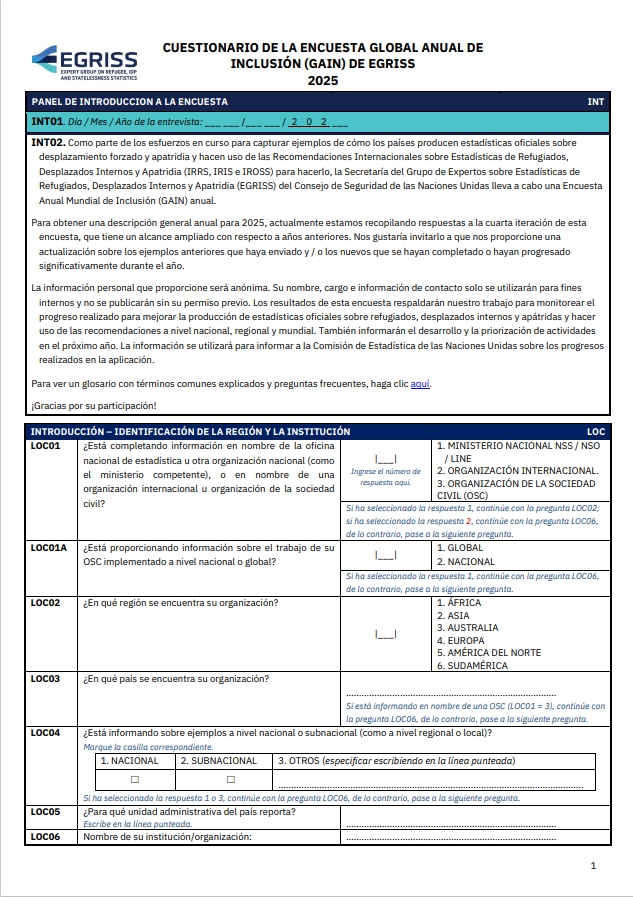
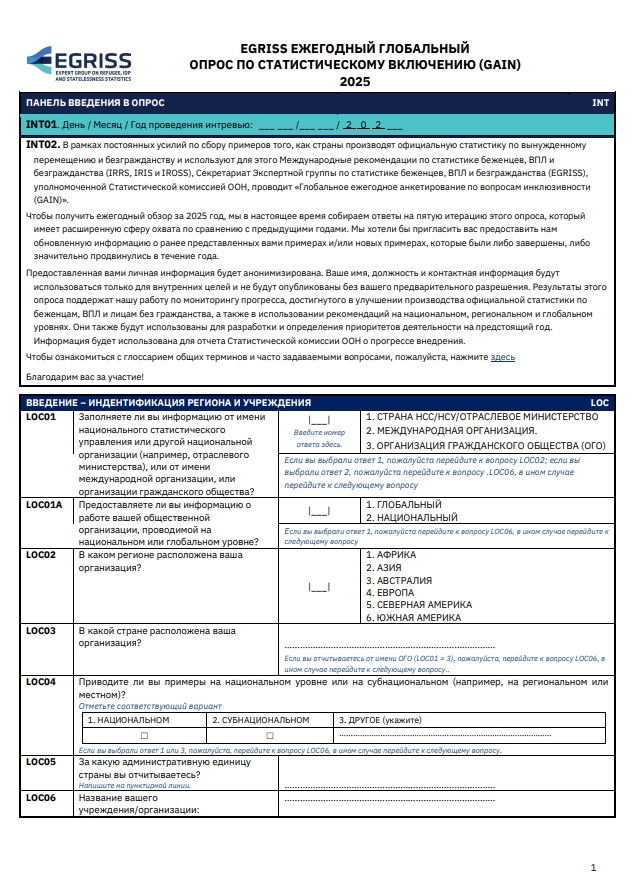
Download the latest GAIN Survey questionnaire, available as a paper version in five languages.
Glossary
Key terms used in the GAIN Survey. Definitions are consistent across all survey rounds.
No terms match your search.
-
An organised initiative taking place in the survey year that includes or solely focuses on improving/producing national statistics on refugees, IDPs and/or stateless people. These examples encompass a wide range — they might involve working on a data source like implementation of a survey, administration of a database, work on a census, a data integration project between different data sources, or work on a non-traditional data source. Examples could also be tools like developing strategies, guidance documents, or the organisation of training sessions and workshops. Examples can occur at different levels, whether on a national, regional, or global scale, and they may be at various stages of progress, including planning or implementation phases. Additionally, examples can entail collaboration with partners.
Example leads can be countries, institutions or CSOs (or other). Country-led examples include activities led by National Statistical Offices or another Government entity conducted in their national context, usually as part of the national statistical system. Institution-led examples are led by international organisations without explicit country leadership. CSO-led examples are led by civil society organisations or other entities.
-
An example that is ongoing at the time of the GAIN Survey, meaning that some time / capacity / staffing / financial investments have been made, for example, survey design / budgeting / training / enumeration / listing or other example-related activities have started.
-
An example for which no significant investments have yet been made in terms of design, budgeting, training, listing, or enumeration. The Future Examples (FPR) section enables respondents to provide details on anticipated examples planned for an upcoming survey year. Responses provided support forward-looking planning and help identify emerging trends, align efforts across stakeholders, and enhance collaboration between national, regional, and international actors to advance statistical inclusion efforts.
-
The involvement of a national, international, or academic partner in the implementation of an example. Respondents may list multiple partners for a single example.
-
Data sources and tools used to provide information on the example can be: (A) statistical surveys, (B) government records and databases, (C) general population censuses, (D) combining data from many places, (E) non-standard sources like humanitarian groups or social media data, (F) developing strategic documents, (G) following guidelines or toolkits, (H) giving training or workshops to get data, and any other source not listed where data comes from.
-
Significant difficulties encountered during an example. Categories include: incomplete response coverage, data collection errors, difficulties identifying specific groups (refugees, stateless), data confidentiality concerns, resource constraints, political or security issues, data quality delays, lack of technical skills or tools, and insufficient guidance.
Frequently Asked Questions
Process and practical questions about completing the GAIN Survey. For terminology, see the Glossary above.
-
The GAIN Survey is designed for countries (NSOs or other responsible agencies) and national, regional, and international organisations working to enhance official statistics related to refugees, individuals in need of international protection, IDPs, or stateless persons. The purpose is to collect information on planned, ongoing, or completed statistical examples involving forcibly displaced and stateless populations, and to support decision-making in EGRISS's work.
-
The questionnaire should be completed by the focal point or the most knowledgeable person in your organisation regarding the related statistical example. You can include contact information for several colleagues if necessary, who were contributing to the provided information.
-
The time required typically ranges from 10 to 20 minutes, depending on the number of examples you have to report. Most questions are designed for quick, concise responses, with only three open-ended questions requiring brief descriptive answers.
-
Participating in the GAIN Survey allows EGRISS to gather comprehensive and accurate information, enabling better addressing of the unique challenges faced by practitioners making efforts to include these populations in official statistics. Your input is instrumental in shaping policies and strategies in this regard.
-
EGRISS encourages you to report all examples and provide as much information as possible for each one. This applies to both country-led and institution-led examples; please also report examples that you are supporting as a partner institution, as well as examples implementing novel or exploratory methodologies.
-
You can include multiple examples in a single questionnaire. When completing the survey, you will be able to add additional examples (question PRO02) and provide relevant information for each one.
-
Yes, please include information about examples that are either in the design/planning or implementation phases, or have been completed during the survey year. These should be reported in the PRO section of the questionnaire.
-
Yes, even without examples to report, your input is still valuable. The GAIN Survey includes questions about planned future examples (FPR section) and the use of EGRISS outputs or recommendations. Sharing information on upcoming initiatives or explaining why no examples are available provides essential context for EGRISS, helping identify gaps and prioritise support where it is needed most.