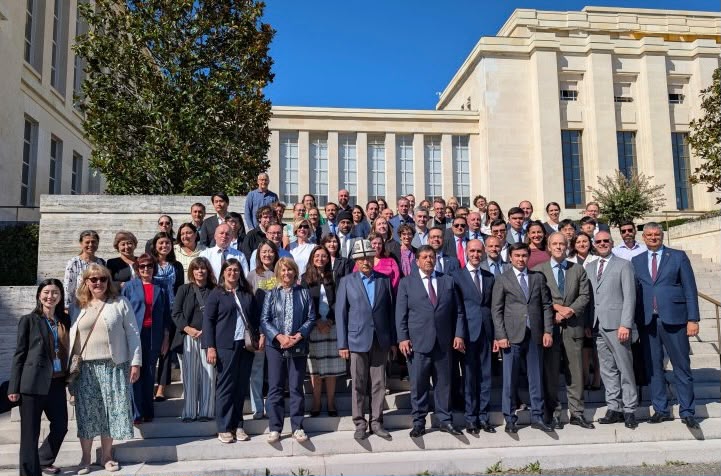
The twenty-eighth meeting of the United Nations Economic Commission for Europe (UNECE) Group of Experts on Statistics on Population and Migration took place in Geneva from 23 to 25 September 2026. A dedicated session on measuring hard-to-reach groups showed that progress on statistics on refugees and asylum seekers is coming from two complementary directions: better use of administrative data through record linkage and field surveys that capture what administrative sources cannot see. Geneva, 23-25 September 2026.
Record linkage is turning administrative data into longitudinal evidence
Istat, the Italian National Institute of Statistics, presented a longitudinal analysis based on the linkage of successive annual residence permit archives held by the Ministry of the Interior, following the 2014 and 2016 first-permit cohorts. The results show that only about 30% of those who obtained an asylum-related permit are still present after five years. Retention is higher among women and varies considerably by citizenship, and mobility across provinces is high. For the first time, it was also possible to identify long-term residence permits within the population under international protection, offering new evidence on settlement trajectories.
The Central Statistics Office of Ireland showed how the same logic can be applied to economic integration. Linking Daily Expense Allowance records, which identify international protection applicants in state accommodation, with earnings data from administrative sources made it possible to follow employment outcomes over 2022-2024. Employment rates rise markedly with time since arrival, employment is concentrated in a few sectors, and median weekly earnings remain below those of the general employed population.
Field surveys complete the picture
Daria Mendola (expert from University of Palermo) presented two Italian surveys designed for populations that lack a sampling frame: Out of Sight (2015), carried out in informal settlements together with Médecins Sans Frontières, and the nationwide Italian Refugees and Asylum Seekers Survey, ItRAS (2024), based on the Centre Sampling Technique, which draws respondents from public hubs such as places of worship, markets and service centres. Both surveys show that carefully designed fieldwork, supported by ex-post weighting, mediators with a migration background and strong ethical safeguards, can reach people who are absent or only partially visible in administrative sources. They also document dimensions that registers rarely capture, including health, living conditions, family networks, vulnerability and migration projects.
The way forward
It lies in combining the two approaches: extending record linkage to asylum applications and decisions and to socio-economic sources, and using surveys to validate, enrich and interpret administrative evidence. Together, they can move statistics on refugees and asylum seekers from counting legal status to understanding actual living conditions and integration outcomes.
A dedicated Task Force
The meeting also relaunched the UNECE Task Force on Statistics on Refugees, Internally Displaced Persons and Statelessness, established by the Conference of European Statisticians for the period March 2026 to June 2028. It will take stock of national practices and their alignment with the International Recommendations, and deliver practical recommendations and good practice examples. Statistical offices and organisations from across the region are welcome to join.
Presentations and papers are available on the meeting page.