
Kenya
Including refugees in national demographic and household budget surveys
Kenya has hosted refugees and asylum seekers since the early 1990s, when civil conflicts across the Horn of Africa sent hundreds of thousands of people fleeing across borders. For over three decades, the government has provided protection and basic services to these communities in collaboration with multiple national and international partners, primarily in camps located in Turkana and Garissa counties.
The Kenya National Bureau of Statistics (KNBS) recognised that national statistical operations rarely captured the refugee population in any systematic way and this left significant gaps in national statistics. As Kenya moved toward more inclusive refugee policies, including through the proposed Shirika Plan for socioeconomic integration, the demand for quality data on refugee living conditions grew. In 2025, KNBS undertook two major survey operations that included refugees: the Kenya Mini Demographic and Health Survey (Mini DHS) and the launch of the 2026 Kenya Integrated Household Budget Survey (KIHBS). The two surveys, using different approaches, together demonstrate significant progress in terms of statistical inclusion building on earlier achievements and lessons learnt from the 2019 census and 2021 Kenya Economic Survey.
The Kenya Mini Demographic and Health Survey
The Demographic and Health Survey is a globally standardised instrument, with core questions designed to ensure comparability across countries and over time. This standardisation limits the flexibility available to individual countries. For the Mini DHS in Kenya, refugee identification relied on existing migration questions about nationality and reasons for leaving one’s country of origin. Respondents who reported seeking asylum could be identified, but there was no dedicated sampling frame targeting refugee populations.
The Mini DHS also faced funding constraints. The global DHS programme had long been supported by the United States Agency for International Development (USAID), but recent funding cuts affected many countries, including Kenya. The survey proceeded through a combination of support from the Aga Khan University and the United Nations Population Fund (UNFPA). A Technical Committee including the Ministry of Health, the World Health Organization (WHO), academia, and the National Population Council oversaw the process.
Data collection happened across 30,000 households in 1,000 communities nationwide and is complete, with the survey currently in the secondary editing phase. For the first time, Kenya used WHO’s Global Scales for Early Development (GSED), a tool specifically designed to assess the development of children from birth to three years old, which was adapted to the local context, to capture how children are thinking, communicating, and interacting. Analysis took place in March 2026, with reports expected by April. While the Mini DHS provides valuable health and demographic data for any refugees captured in the general population sample, it does not offer representative coverage of the refugee populations.
The Kenya Integrated Household Budget Survey
The Kenya Integrated Household Budget Survey presented a different opportunity as it offered more flexibility for methodological refinement. When the World Bank (funding the survey through Program-for-Results Financing), UNHCR, and the Department of Refugee Services (DRS) approached the statistical office about including refugees, the opportunity aligned with work that technical staff had already been advocating for internally. Strong support from KNBS senior management, particularly the Director General, helped move the initiative forward.
Since refugee camps are not included in Kenya’s Household Master Sample Frame, KNBS developed a separate sampling frame specifically for this population. The team started with enumeration areas from the 2019 Population and Housing Census cartographic mapping, updating the information before data collection. Working with DRS and UNHCR, they first delineated the camps — Kakuma and Kalobeyei in Turkana County, Dadaab in Garissa County — and separated them from surrounding host communities.
Household identification relied on UNHCR registration systems, and registration numbers served as unique identifiers, generating listings for each cluster. From these identifiers, KNBS created its own household numbering system for sampling purposes. Camp residents were assumed to be refugees or asylum seekers based on DRS/UNHCR registration lists, with the distinction between the two captured through specific survey questions.
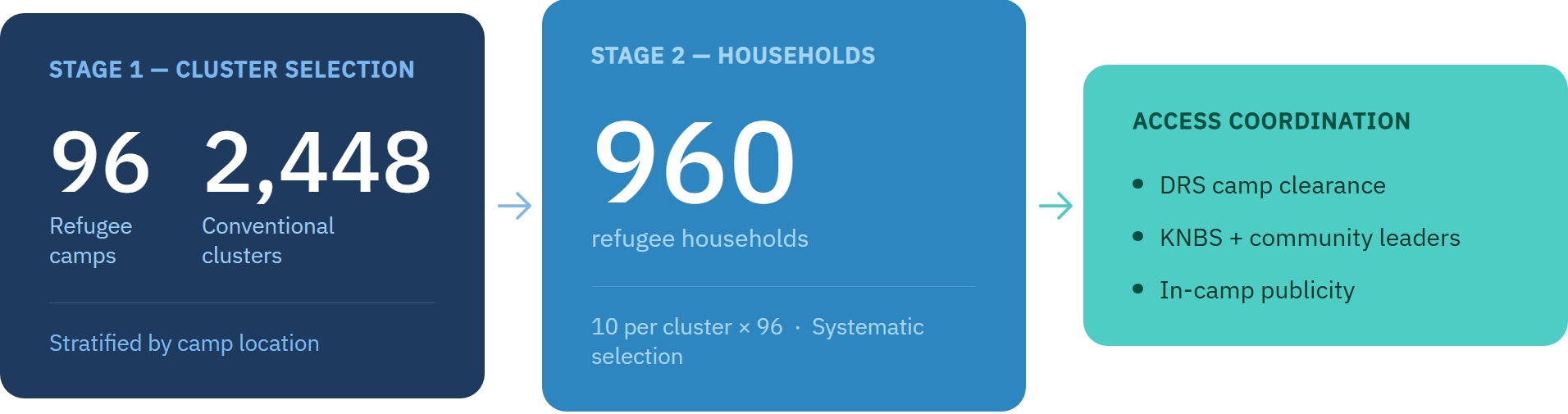
A two-stage stratified cluster sampling was adopted. In the first stage, 96 clusters were selected from refugee camps alongside 2,448 clusters from the conventional population. Stratification by camp location ensured that each major settlement was represented. In the second stage, 10 households were systematically selected from each cluster, producing a refugee sample of 960 households. Accessing the camps required coordination with DRS, and KNBS worked with community leaders and conducted publicity within the camps to explain the survey’s purpose.
The KIHBS refugee sampling frame covers camp-based refugees only. Urban refugees are not specifically targeted. Some may be captured in the general population sample through questions on nationality and reasons for migration. KNBS views this as a first step, with potential expansion to urban refugees in future rounds.
Data collection began in July 2025 and will continue through June 2026, with final reports expected in early 2027.
Use of the International Recommendations
The KIHBS questionnaire includes modules on migration aligned with the International Recommendations on Refugee Statistics (IRRS). Key concepts for refugees and asylum seekers were defined in advance, with the distinction between the two populations captured through specific survey questions. The survey covers demographics, education, health, household consumption and expenditure, income sources, and social protection. Additional modules address migration, emigration, mental health, and natural resource management. For refugees, these modules generate data on living standards, service access, and poverty status that can be compared directly with the national population—addressing questions that policymakers and humanitarian actors have long asked but lacked evidence to answer.
The Mini DHS, while more constrained, also captures some IRRS-relevant information through its standard migration questions on nationality and reasons for movement. Refugees identified in the general population sample will have health and demographic information recorded alongside the national population, enabling at least partial comparison on indicators such as fertility, family planning, maternal health, and child nutrition.
Conclusion
Kenya’s inclusion of refugees in the 2025-26 survey cycle demonstrates how inclusive national statistics can make displaced populations visible through multi-stakeholder coordination, providing a foundation for sustained inclusion of displacement in national policies and response. Senior leadership commitment within KNBS was critical to move the initiative from concept to implementation. These surveys will generate data to support multiple policy objectives. Kenya’s proposed Shirika Plan represents a shift toward socioeconomic inclusion for refugees. Evidence from the KIHBS will inform its implementation, providing the baseline data needed to design and evaluate integration programmes.
The data will also enable SDG monitoring with disaggregation by displacement status, allowing Kenya to report on refugee outcomes alongside the national population for indicators related to poverty, education, health, and employment, fulfilling commitments under the Global Compact on Refugees and contributing to global evidence on refugee inclusion. Looking ahead, these surveys are also milestones towards the full coverage of refugees in the 2029 population and housing census. The sampling frame developed for the KIHBS, the partnerships established with DRS and UNHCR, and the experience gained in accessing and enumerating refugee populations all create precedent and capacity that can be drawn on for future operations.
COVER PHOTO: Kenya. Complementary Pathways. Durable solutions. Education. Resettlement. Scholarship. Malengo. © UNHCR/Mohamed Maalim