
United Nations Refugee Agency
Aligning UNHCR’s statistics with the IRRS, IRIS, and IROSS
In line with its global mandate, UNHCR publishes official population statistics on forcibly displaced and stateless people biannually on the Refugee Data Finder website as well as analytical summaries of these statistics in the Global Trends and Mid-Year Trends reports. These statistics are collected and published by UNHCR from a wide range of data sources and stakeholders that use different definitions and statistical frameworks, with efforts made to align reporting for a coherent global picture.
First published in 1951, UNHCR’s official population statistics have expanded as data has become more widely available and increasingly disaggregated. With the publication of the IROSS in 2023, the International Recommendations approved by the UN Statistical Commission covered all population groups included in UNHCR’s statistics. Therefore, it was timely and relevant to assess how UNHCR’s statistical framework could be refined to better reflect the International Recommendations and guide improvements in UNHCR’s source data, much of which is provided by governments.
Since the endorsement of the IRRS, IRIS, and IROSS, UNHCR has been actively involved in promoting and supporting their implementation with stakeholders in various national and regional contexts. Given progress made in the past few years, UNHCR’s statistics team took the initiative to review its statistical frameworks in 2023 against those approved by the UN Statistical Commission as guidance for official statistical production. This case study describes the process followed and emerging results.

A comprehensive review of statistical frameworks
Initiated in 2023, the project evaluated how UNHCR’s framework for population statistics on forcibly displaced and stateless people compare to the three International Recommendations (IRRS, IRIS, IROSS). Under the leadership of UNHCR’s Chief Statistician and in collaboration with the EGRISS Secretariat, the project also assessed the feasibility of enhancing this alignment over time. The first step was to compare the frameworks overall and by population category. For example, does the definition of asylum-seekers according to IRRS differ from the one UNHCR applies for its statistics? How well do the population categories included in the IROSS statistical framework match the definitions of statelessness in UNHCR’s global estimates?
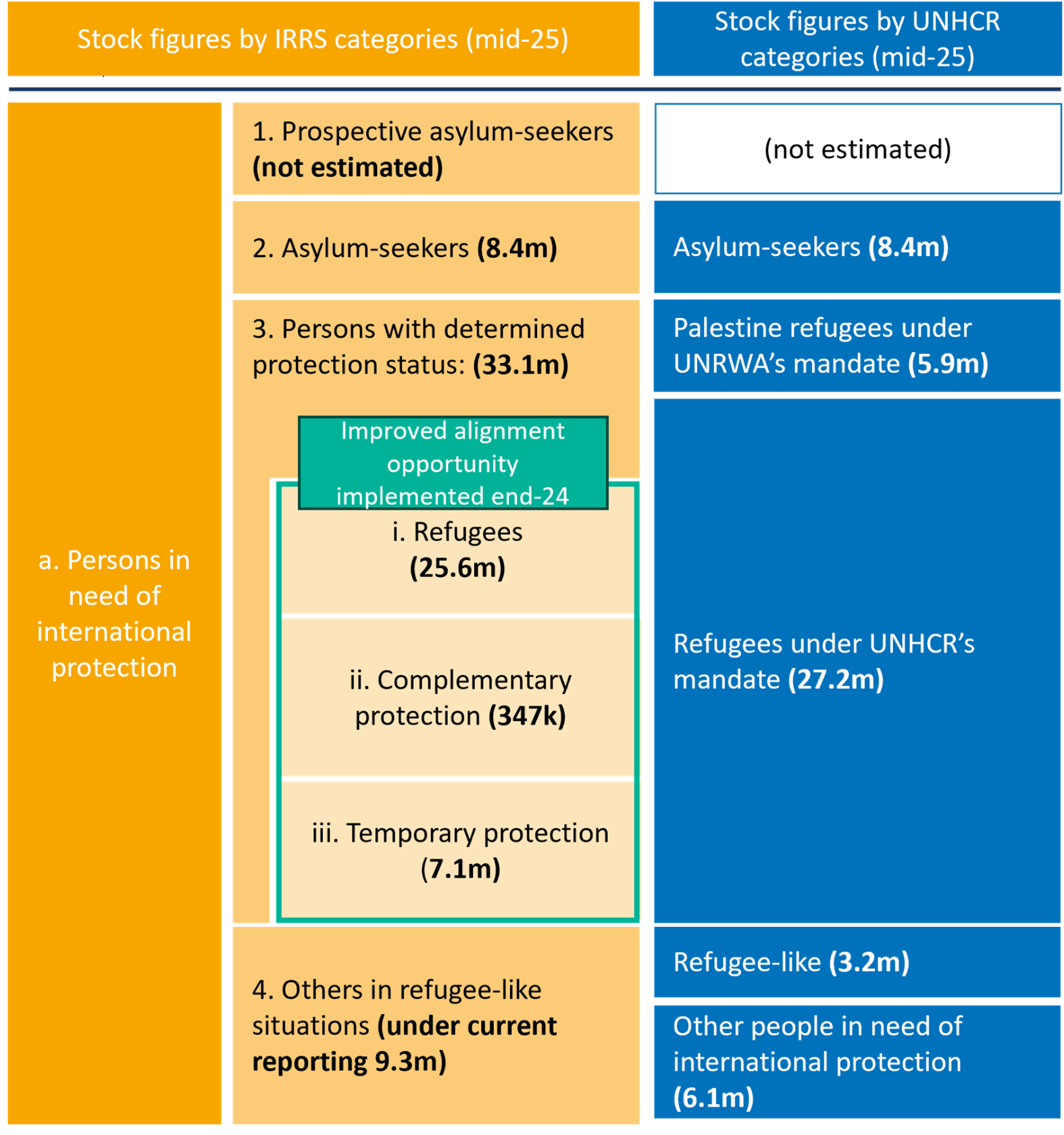
The analysis of the alignment between frameworks included, where possible, a quantitative comparison and recommended actions (short-term, medium-term, and longer-term) that could be taken to improve the alignment. The results were summarised in a comprehensive internal report and, in 2024, were incorporated into an interactive dashboard to facilitate comparison, internal consultations and decision-making on the actions proposed. Overall, the results indicated a high alignment with IRRS and IROSS.
Some opportunities to improve alignment have since been implemented during 2024-2025 (e.g. Disaggregation of refugee stock by protection status), with additional implementation steps to follow for 2026 (Implementation of IROSS framework for disaggregating statelessness statistics with emphasis on statelessness recognition). For IDP statistics, UNHCR’s statistical framework and IRIS differed, with additional complexity in adapting the frameworks due to the shared custodianship of IDP data.
Use of the International Recommendations
As described, the International Recommendations provided the foundational reference for this initiative. In particular, it utilised the statistical frameworks, population definitions, and descriptions set out in the IRRS, IRIS, and IROSS. The International Recommendations represent critical guidance about improving the quality of statistical production processes. As a trusted leader on data and information related to forcibly displaced and stateless people, UNHCR fully supports the EGRISS standards and, where possible, aims to closely align its forced displacement statistics with the guidance set out in the International Recommendations. The steps taken so far are therefore understood as initial steps to more fully align with these international standards, which themselves are expected to be updated and improved over time in line with EGRISS’ 2026-2030 TOR.
“Users of our statistics are increasingly discerning about gaps in data availability and quality issues, especially inconsistencies. This alignment exercise has helped immensely to guide where UNHCR will focus on improving its statistics in collaboration with host countries and other stakeholders”.
— Edgar Scrase, Senior Statistics and Data Analysis Officer, Statistics and Information Management Section, Global Data Service
Conclusion
Although implementation of the project is still underway, results are already demonstrating the positive impacts of better harmonised global statistics. These are tangible from the internal consultations that have provided concrete opportunities for mainstreaming and socialising the IRRS and IROSS frameworks.
As several of the identified longer-term alignment opportunities rely on further improvements to the quality and availability of nationally produced data on forcibly displaced and stateless populations – i.e. through the incorporation of the IRRS, IRIS, and IROSS in national data production processes – UNHCR is hopeful that further steps can be taken in the coming years as the “statistical inclusion” agenda gains momentum. For other data-producing entities, UNHCR’s efforts to strengthen alignment with the International Recommendations may serve as a reference for exploring similar alignment initiatives.
COVER PHOTO: New IDPs in Tawila waiting to collect plastic sheets. © UNHCR/Mohammed Jalal