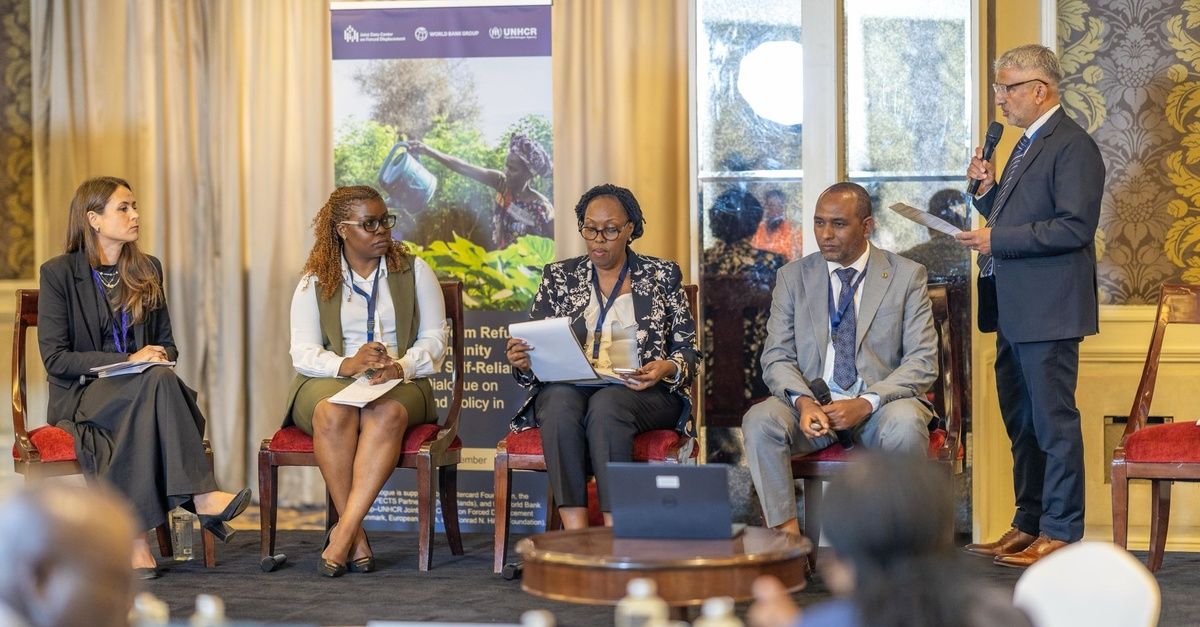
Government representatives, national statistical offices, development and humanitarian partners, researchers and refugee-led organisations met in Nairobi on 15 and 16 September 2026 for the Evidence to Inform Refugee and Host Community Inclusion and Self-Reliance: A Regional Dialogue on Operations and Policy in East Africa. Convened by the World Bank, UNHCR, and the World Bank–UNHCR Joint Data Center on Forced Displacement (JDC), the event centred on the inclusion frameworks of Kenya, Ethiopia, and Uganda, which together host more than four million refugees and asylum seekers. It looked at how data can better support national reform agendas, the move from parallel humanitarian services to integrated, government-led service delivery, and job creation and private investment in refugee-hosting areas.
Opening the dialogue, Chris Gabelle, Senior Social Protection Specialist at the World Bank Group, placed these reforms against shrinking aid budgets. He argued that decisions on how to use scarce resources “must be data-centred and evidence-based”, including in support of UNHCR’s “50 by 35” goal. Martin Manteaw, Head of Bureau Strategic Planning and Management Service at the UNHCR Bureau for Eastern and Southern Africa, made the case for statistical inclusion plainly: “A refugee recorded in a national survey is a refugee a planning ministry can budget for. That shift, from a humanitarian dataset to an official statistic, is what everything else follows from.”
Maja Lazić, Deputy Head of the JDC, described how far the field has come: “Not long ago, refugees, internally displaced people and stateless people were invisible in national statistics. Invisibility has consequences: what is not counted is rarely planned for, budgeted for, or effectively addressed”. Since 2021, over 335 examples of national statistical systems including forcibly displaced people have been recorded through the Global Annual Inclusion Survey (GAIN) Survey. Donor representatives drew the same link between evidence and results. Tiest Sondaal (Deputy Head of Cooperation/Regional Coordinator for Refugees and Migration at the Embassy of the Kingdom) cited World Bank findings that the annual cost of aid per refugee in Ethiopia fell from around US$280 to US$80 once refugees gained the right to work and freedom of movement. Henrik Larsen (Head of Cooperation at the Royal Danish Embassy in Kenya) stressed that “good data should not be an end in itself; it should help governments and partners make better choices.”
Formally opening the dialogue, Dr. Belio Kipsang, Principal Secretary of Kenya’s State Department for Immigration and Citizen Services, highlighted that refugees living in camps were included for the first time in the 2025–2026 Kenya Integrated Household Budget Survey (KIHBS). “Our ambition should be to make this kind of inclusion routine across national statistical and administrative systems,” he said, as he called on the three countries to deepen regional learning and harmonise evidence standards.
Refugee inclusion must be practical, measurable and sustainable. Evidence must move us from policy intention to policy implementation, and from implementation to demonstrable results.
 Dr. Belio KipsangPrincipal Secretary, State Department for Immigration and Citizen Services, Kenya
Evidence to advance policies: three countries, three roadmaps
Kenya’s Shirika Plan, Ethiopia’s Makatet Roadmap and Uganda’s National Transition Strategy were presented side by side. Muhamed Husein, M&E Team Leader at Ethiopia’s Refugees and Returnees Service (RRS), explained that the Makatet Roadmap, named after the Amharic word for inclusion, integrates refugees into national economic activity and social services. “Data and information are very crucial for decision-makers and for crafting policy,” he said. Husein pointed to the jointly conducted socioeconomic survey of refugees, whose findings fed into Ethiopia’s Right to Work Directive, and to household survey evidence showing that host communities and refugee markets benefit from trading with each other. To turn the roadmap into practice, Ethiopia now needs comprehensive baseline data on host community capacity and local infrastructure, alongside the integration of refugee data into the national statistical system.
Helen Bugaari, Director of Uganda’s Comprehensive Refugee Response Framework (CRRF) Secretariat, presented the draft National Transition Strategy. It aims to move partner-managed education, health and water services to government planning and management by 2035. She gave concrete examples of how evidence has shaped policy. Refugees are now included in Uganda’s fourth National Development Plan (NDP IV), which means services for them “can now be budgeted for without question, on the same basis as for host communities.” Refugees were also counted for the first time in the latest national census. She was candid about the gaps as well. Only about 11% of refugees are currently considered self-reliant, and the transition strategy still lacks a baseline study of the full scale of sectoral gaps.
For Kenya, Diana Odari, National Coordinator for the Shirika Plan at the Department of Refugee Services (DRS), described the plan as a government-led shift over 2025–2036 towards development-oriented service delivery in the refugee-hosting municipalities of Dadaab, Hagadera and Kakuma. Developing its implementation framework showed how much data still matters. Baseline data was hard to access and often scattered, which raised questions about data integrity. Until recently, she noted, refugees were not part of major government statistical reports, and the Kenya National Bureau of Statistics (KNBS) is now starting to fill that gap.
Shirika Plan
“Shirika” means “coming together” in SwahiliA government-led shift towards development-oriented service delivery in the refugee-hosting municipalities of Dadaab, Hagadera and Kakuma, implemented in three four-year phases.
Makatet Roadmap
“Makatet” means “inclusion” in AmharicIntegrates refugees into national economic activity and basic social services, built around six pillars, without replacing the pursuit of durable solutions.
National Transition Strategy
Draft strategy, well advancedMoves partner-managed education, health and water services to government planning and management, in a phased ten-year approach.
Making displacement data visible in national data systems
With the national statistical offices taking the floor, the event considered how refugee-inclusive statistics are produced, institutionalised and used. Rosemary Chepkoech, Director of Population and Social Statistics at the KNBS, described how Kenya built a dedicated sampling frame to include a representative sample of refugee households in the KIHBS. The work was done in partnership with the Department of Refugee Services, the World Bank and UNHCR. She underlined the role of global guidance: “International standards matter very much. We have been able to engage with EGRISS and to work on the implementation of the International Recommendations on Refugee Statistics, so that the concepts, definitions and disaggregation of the statistics are done to an internationally acceptable standard.” Looking ahead, she called for refugee statistics to “become part of our regular national statistical programme”, backed by stronger administrative data systems and sustained investment from development partners in national statistical capacity.
Ethiopia has set up dedicated institutional structures and a national coordination mechanism to respond to growing demand for displacement statistic, as explained by Million Taye, Head of the Migration and Urbanization Statistics Desk at the Ethiopian Statistical Service (ESS). He pointed to the 2023 socioeconomic survey conducted with the World Bank and UNHCR as a key source for policy and for the Makatet Roadmap. He was frank about the methodological hurdles in a country of Ethiopia’s size, where refugees concentrated in camps and specific urban areas are hard to sample alongside the host population. His prescription for sustainability was clear: “We have to move from project-based refugee data collection to an inclusive national statistical system. Otherwise, we collect data one time and it is not continued.”
Sharon Apio, Head of the Department of Demography and Social Statistics at the Uganda Bureau of Statistics (UBOS), said refugee inclusion is now built into the design of almost every survey. Uganda’s lessons include close coordination with the Office of the Prime Minister and line ministries to harmonise data collection, and regular updates to the refugee sampling frame. In the country’s recent education census, refugee learners were often attending host community schools while host children attended schools in the settlements, which has informed how services are planned. She highlighted work to domesticate global standards such as IRRS through national guidelines for harmonising migration statistics and warned that sustained training is essential as staff who pioneered refugee inclusion retire and a new generation takes over.
Learning from each other
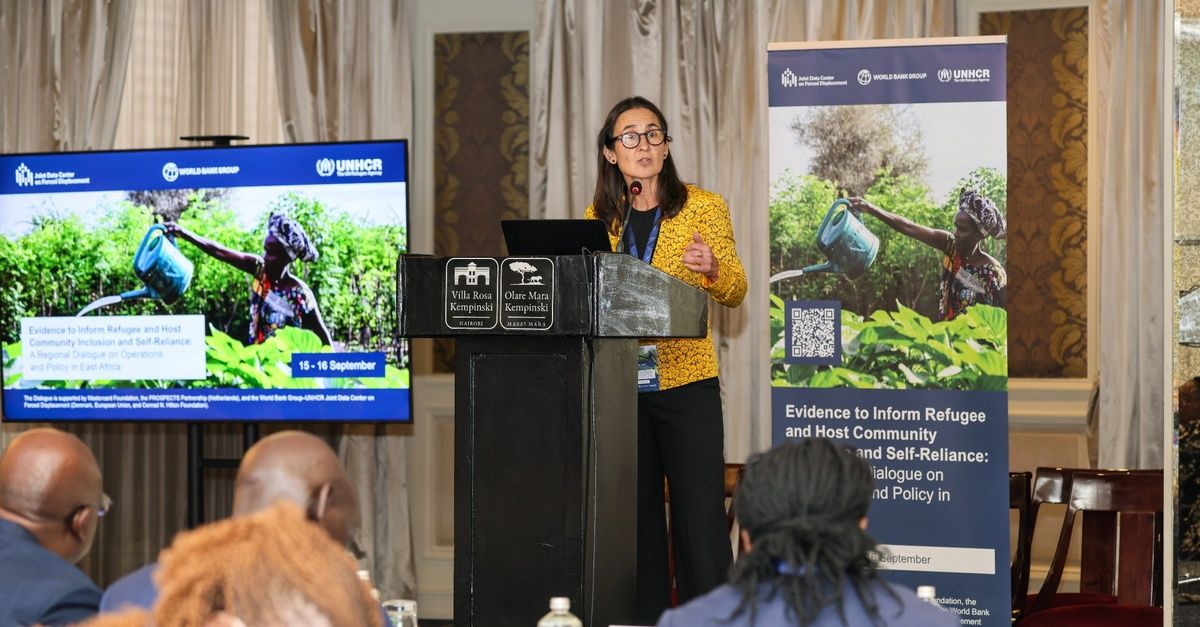
Across the two days, the International Recommendations on Refugee, IDP and Statelessness Statistics (IRRS, IRIS and IROSS) were a constant reference point for statisticians and policymakers alike. Kenya, Uganda and Ethiopia are putting them into practice in different ways: new sampling frames, national guidelines and coordination mechanisms. Each has lessons the others can use. For EGRISS, this is the kind of peer exchange its network is built on, and the experiences shared in Nairobi will help other countries on the same path to make forcibly displaced and stateless people visible in their national statistics.
Between the three of you, we have an incredible list of lessons – something we can also use in the EGRISS network by way of peer-to-peer learning with other countries.
 Maja LazićDeputy Head, World Bank–UNHCR Joint Data Center on Forced Displacement
Speakers’ calls for sustained training, stronger capacity, and a shift from one-off exercises to routine national production echo the focus of EGRISS’ capacity-strengthening work. Its free E-learning Course offers practitioners and data users an accessible introduction to all three sets of Recommendations, while the new open-source Training Package provides a set of materials covering key areas for statistical inclusion. In addition, the Compilers’ Manual, now being revised is being revised to include statelessness content and lessons learnt and will draw on good practices such as those shared by the three countries Together, these tools help turn peer learning into lasting practice and enhance institutional capabilities to produce high-quality, comparable, and policy-relevant data.