5 June 2026
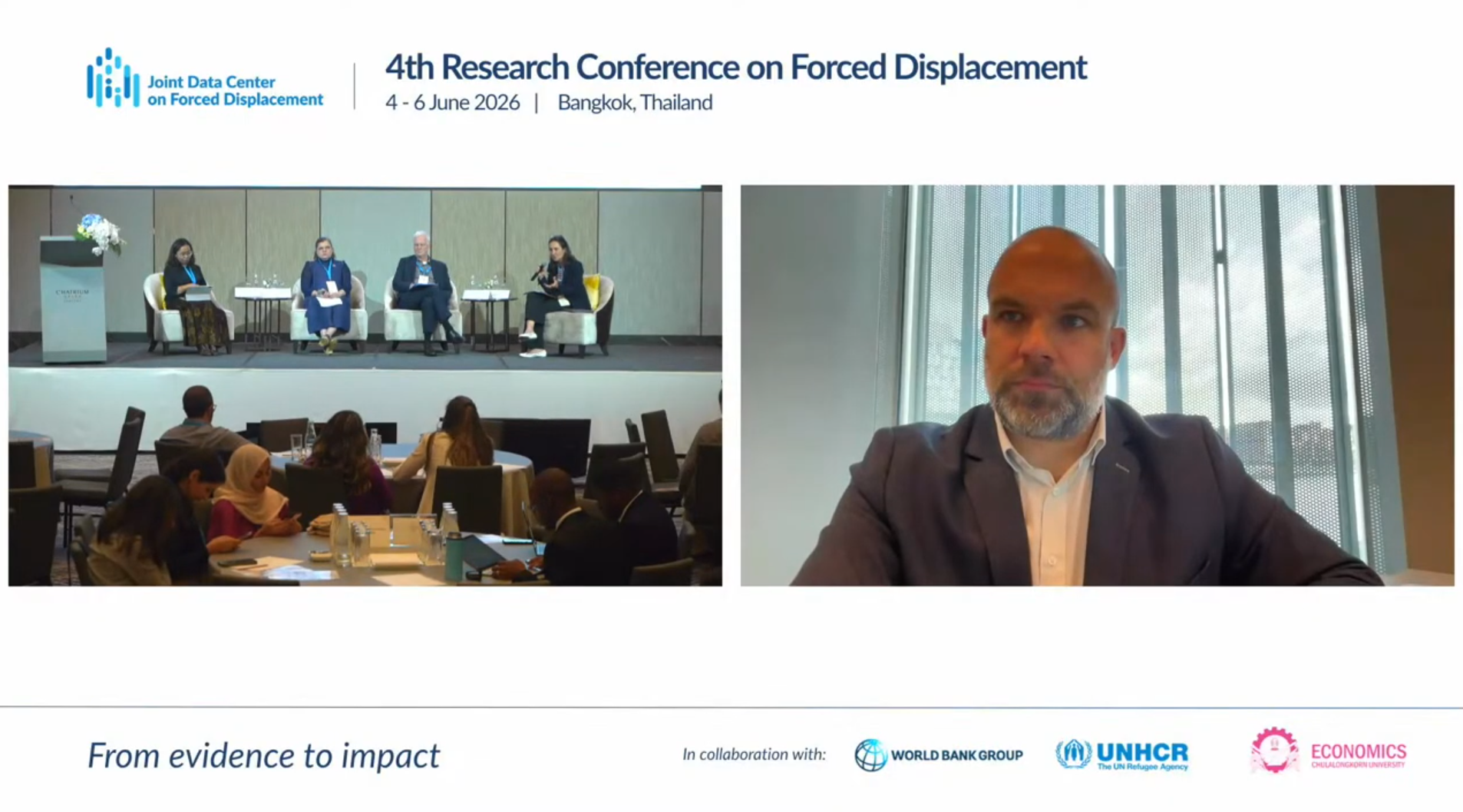
At the 4th Research Conference on Forced Displacement, organised by the WB-UNHCR Joint Data Center on Forced Displacement (JDC), a dedicated strategic dialogue brought together key perspectives from across the statistical, humanitarian, and development communities to reflect on one of the recent transformations in how we understand and respond to forced displacement: inclusion in national statistics. Moderated by Maja Lazić, Deputy Head of the JDC, the session drew on insights from Olivier Dupriez, Deputy Chief Statistician and Advisor in the Development Data Group at the World Bank; Rachael Beaven, Director of the Statistics Division at the UN Economic and Social Commission for Asia and the Pacific (ESCAP); Volker Schimmel, Head of UNHCR’s Global Data Service; and Winida Albertha, Senior Statistician at BPS-Statistics Indonesia. Together, they mapped a journey from early ambition to growing reality – and took stock of what it will take to sustain and accelerate progress.
Maja opened the dialogue with a clear framing for the discussion: “statistical inclusion of forcibly displaced and stateless populations is no longer a technical issue, but a policy imperative and increasingly becoming a best practice”. She also flagged the GRF multi-stakeholder pledge on inclusion in national statistical systems, which has helped cement the political foundations to further advance this agenda.
“In a context of shrinking budgets and rising needs, better data and better statistics is essential for better decisions, better targeting, and more coherent responses. Statistical inclusion strengthens national leadership and really brings together the government, the development actors, and the humanitarian agencies around a shared evidence base”
– Maja Lazić, Deputy Head of the JDC
The Role of EGRISS
EGRISS was a recurring reference throughout the dialogue as a key enabler of statistical inclusion. Volker reflected on the remarkable shift he has witnessed within UNHCR: “It has been incredible to see how EGRISS in particular, but statistical inclusion as an overall approach, has moved from a specialist discipline to a broadly adopted policy imperative.” He noted that the topic is now championed by senior management and non-technical colleagues who recognise its centrality to UNHCR’s mission on self-reliance and durable solutions.
Olivier echoed this assessment, describing EGRISS as the essential “glue” connecting multiple efforts across development and humanitarian institutions. “If you want the World Bank to pick up a specific agenda, you need to be very convincing. You need standards, guidance, tools, and EGRISS has provided exactly that when it comes to forced displacement statistics.” He highlighted the International Recommendations on Refugee, IDP, and Statelessness Statistics (IRRS, IRIS, and IROSS) as providing the common language that makes engagement between host governments, national statistical offices, and development partners not only possible but productive.
Winida likewise referenced the International Recommendations and was candid about both what Indonesia has achieved and where the limits lie in terms of their implementation.
What Does Impact Look Like?
The dialogue devoted significant attention to the question of impact: what does it actually look like when statistical inclusion changes something? Olivier offered several compelling examples. In Colombia, regular data collection on Venezuelan displaced populations — built in close collaboration with national authorities — contributed to a change in their legal status in the country. In Iraq, analysis combining data on forcibly displaced populations and social protection led to a fairer, more integrated proxy means test for cash transfers.
“When you want to have a dialogue with countries, especially on relatively sensitive issues, having national data, official data, is something that is much more powerful than getting data from private sector, from other places.”
– Olivier Dupriez, Deputy Chief Statistician and Advisor in the Development Data Group at the World Bank
For Volker, impact is also visible in the changing nature of UNHCR’s relationships at country level: “To see so many UNHCR offices speaking to the National Statistical Office, that is a sea change.” He cited the work in Pakistan and in Zambia, where data produced jointly with the national statistical office directly influenced how the European Union directed investments in favour of refugee inclusion. Winida described how Statistics Indonesia’s work with ESCAP to produce a first-ever civil registration and vital statistics report revealed that more than three million children in Indonesia were unrecognised in the system.
Challenges on the Road to Inclusion
The panel did not shy away from the real obstacles that remain. Winida spoke candidly about the design limitations of Indonesia’s surveys: while questions on migration reasons, including conflict and disaster, have been included since 2005, the sampling frame was designed for usual settlements, not camps or special arrangements. As a result, the number of observations of displaced populations can be too small to be statistically meaningful.
Volker pointed to the data asymmetry between camp and non-camp populations as a persistent challenge. Camps tend to generate administrative data more readily, but that same separation can become a barrier to inclusion and longer-term solutions. Olivier drew attention to a further challenge: access to microdata, including that produced through national systems, and the funding pressures currently threatening it. He stressed the need for continued investment in statistical disclosure control and data privacy techniques to support national systems and ensure researchers can maintain legitimate access under evolving privacy regulations.
Rachael highlighted the crucial role of trust and community engagement. The biggest barriers are often not methodological but human: fear and mistrust from respondents, especially in communities who feel the need to avoid self-identification. ESCAP’s response has been to champion a whole-of-society approach, ensuring that national statistical offices engage with communities from the very beginning of the process — not just at the data dissemination stage. She also highlighted the value of peer exchange between countries as a powerful accelerator: through ESCAP’s informal online Asia-Pacific Stats Cafés countries present what they are doing on a particular topic. The point, as she put it, is not having all the answers, but about “how are we implementing these things, what are the challenges we’re facing, and then discussing it together, and really learning from each other.”
The Road Ahead
The dialogue closed with a clear sense of momentum, and of what remains to be done. The standards are in place. The number of countries engaged is increasing. The evidence of impact is growing. What is needed now is the discipline to document that impact, to trace how data travels from collection to policy change, and to ensure that the next decade of statistical inclusion is more sustainable, built not on one-off projects but through systems. As Maja put it: “Data cannot sit on a shelf. It needs to have impact, and it needs to be pushed into impact, and the more the national context and governments own it, the more it actually has an opportunity to have impact.”