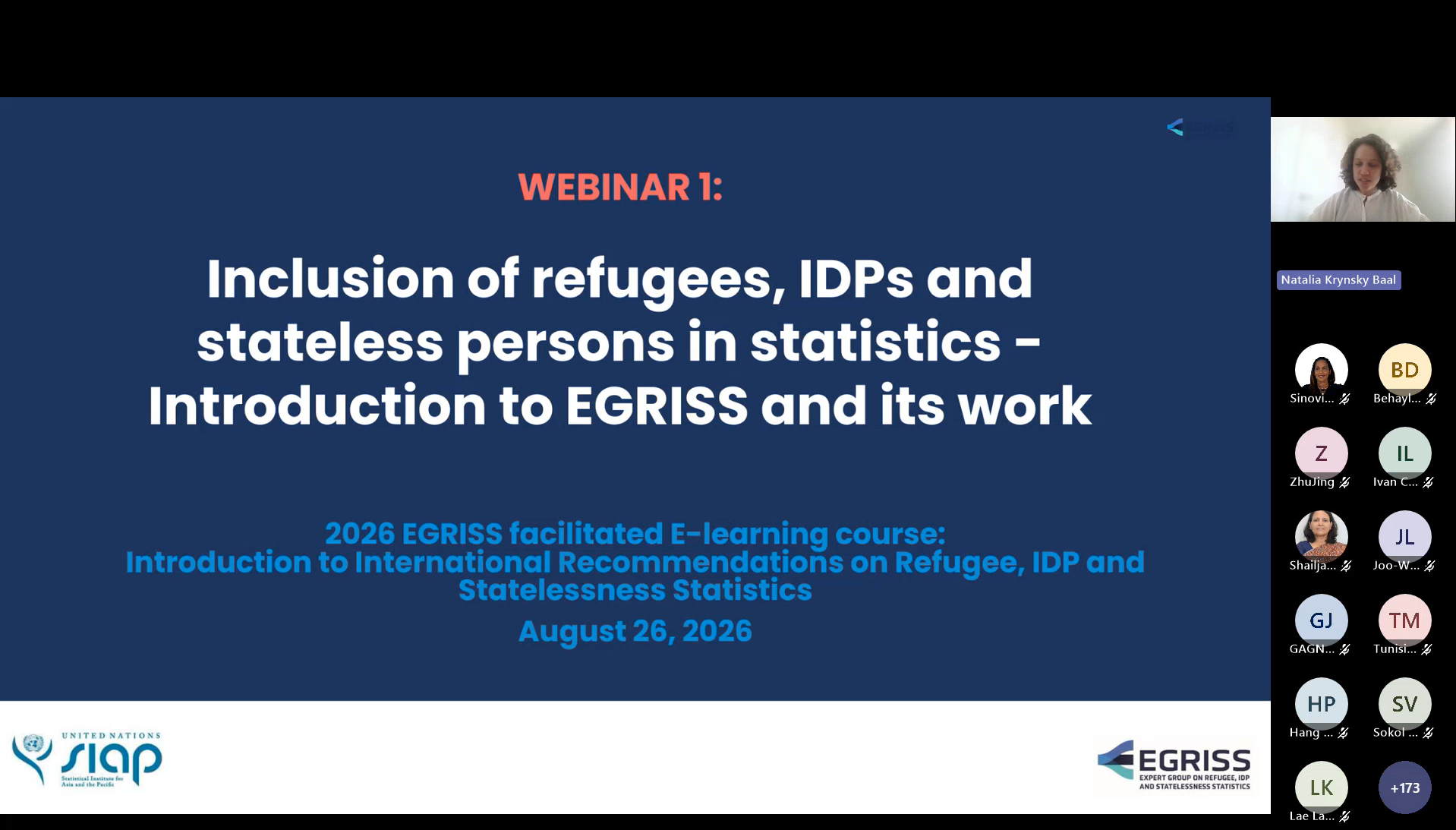
Between 17 August and 9 October 2026, EGRISS and the United Nations Statistical Institute for Asia and the Pacific (SIAP) delivered the third facilitated edition of the e-learning course on the International Recommendations on Refugee, IDP and Statelessness Statistics. With over 420 people enrolled and almost 50% successfully completing the course and passing the final assessment, their evaluation of the programme was overwhelmingly positive: 95% said it enhanced their knowledge and skills, 94% found it relevant to their work, and many described it as well structured, informative and directly useful in their day-to-day work.
The course was open to staff of national statistical offices, line ministries and immigration agencies, as well as international, regional and non-governmental organisations working on forced displacement and statelessness. Over eight weeks, participants worked through six interactive modules on the SIAP learning platform in English, French or Spanish, covering the IRRS, IRIS and IROSS, data sources, analysis and dissemination, and coordination at national, regional and international levels.
Four live webinars ran alongside the modules. In them, EGRISS members presented each set of recommendations, and national statistical offices showed how they are applying them. The sessions were moderated by Sokol Vako and Sinovia Moonie, Statisticians and Lecturers at SIAP.
What participants said
Participants rated the course highly. Of the 200 who completed the final evaluation survey, 94% agreed that it was relevant to their work, and 95% that it enhanced their knowledge and skills and that the interactive lessons were of high quality, clear and concise.
How participants rated the 2026 facilitated e-learning course
Several participants highlighted how the different parts of the course worked together. One noted that they “particularly appreciated the combination of interactive lessons, webinars and practical assessment activities.” Others singled out the country presentations, observing that these “greatly helped to show how the guidance is applied in practice.” For some, the course exceeded expectations: one participant wrote that they had “learned and gained so much knowledge, far more than I expected.”
Participants also valued the depth of the material. One described the course as “a high-quality learning resource that effectively supports capacity building for producing official statistics on forced displacement and statelessness,” and others singled out the modules on coordination, data sources and confidentiality as particularly insightful. The format made the course workable for busy professionals. Participants appreciated being able to study at their own pace, and the webinar recordings and transcripts let those who missed a live session catch up.
For many participants, the course was a reminder of what is at stake behind the numbers. Several noted that good statistics on displacement are not only about counting people, but about doing so ethically, accurately and with full respect for confidentiality and personal identity. They also saw common definitions and coordination across institutions as essential to make sure displaced and stateless people are not left behind.
Looking ahead
Participants also shared ideas for future editions, including more country case studies and hands-on exercises, more time for questions during webinars, and sessions in more languages and time zones. EGRISS and SIAP will draw on this feedback to shape the next iteration planned for 2028.
EGRISS thanks all speakers, moderators and participants, and SIAP for its continued partnership. In the meantime, the self-paced version of the course remains available year-round, in English, French, and Spanish. Find out more here.